
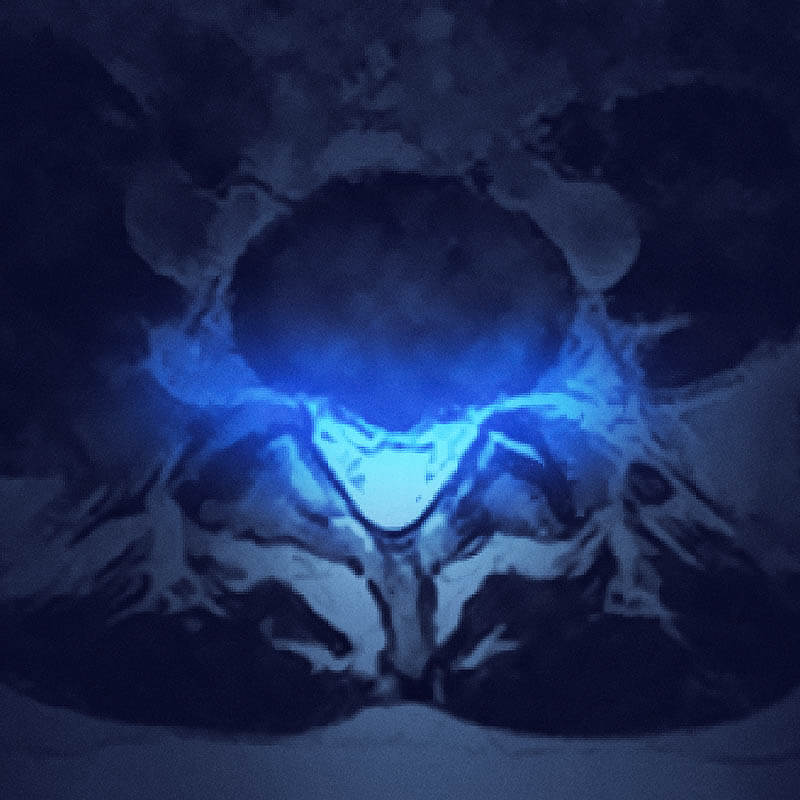
While most herniated discs cause few problems, some can lead to severe and disabling back pain. In addition, they may lead to numbness, weakness, balance or walking problems. Other symptoms may include deep muscle pain and muscle spasms.
A herniated disc can cause a shooting pain and numbness in the buttock and down the leg. This is called sciatica and is the most common symptom when the problem is located in the low back. Pain may also occur in the lower back, although it is usually less intense than leg pain.
Herniated discs in the neck or upper back can cause pain the neck, shoulders and upper arms.
A rare, but serious condition known as “Cauda Equine Syndrome” can develop in the low back, affecting bowel and bladder function as well as leading to partial paralysis of the lower limbs if left untreated.
The spine is formed of 24 vertebrae, or bone segments that are stacked on one another from the pelvis to the skull. These are further divided into several areas:
The spine protects nerve roots that exit at various points from the spinal column and travel to the limbs and other areas of the body. Between the vertebrae of the neck, middle back and lumbar are soft discs filled with a spongy substance. When healthy, these discs protect the spine and keep it flexible.
A herniated disc occurs when the soft center ruptures though the outer wall of the disc structure. This happens when this outer wall (called the annulus) begins to thin, stretch, and come apart, due to aging, wear and tear, or injury. The condition can occur in the neck or middle back, but is most common in the low back, called the lumbar spine. This condition is also called slipped disc.
Herniation has been linked to obesity, improper lifting, smoking, sudden pressure and repetitive strenuous activities.
The type of herniation can vary. From least to most serious, the degrees of herniation are:
If I don’t treat a herniated disc could it lead to more serious conditions?
How do I know if I have a herniated disc?
Will a Herniated disc heal on its own?
What is the difference between a slipped disc and a herniated disc?
What is the difference between a ruptured disc and a herniated disc?
more faqs »
Learn about Herniated Disc treatment options.
To diagnosis and treat most back problems, a doctor will exam a patient for possible nerve involvement, ask about medical history and likely order medical images of the back such as a simple X-ray; an MRI, which provides a view of the tissue around the spine; or a CT scan, which uses a series of X-rays to provide a cross-section view of the spine and surrounding tissues
If the diagnosis is disc herniation, a doctor has a variety of treatment options. Treatments are usually non-surgical, and usually focus on pain management. Surgery occurs only rarely.
They may be as simple as prescribing a common over-the-counter pain medication or as involved as complex surgery.
Most herniated disc treatments will include medication, physical therapy, and occasionally intervention pain blocks. Recovery can take several months. Surgery may be required if these measures fail.
Fortunately, most patients are helped with the least-invasive treatments. Sometimes, this may be non-prescription medicine and an exercise plan designed to improve strength and flexibility in the back, torso and limbs.
The most common approach to treating a herniated disc is addressing the pain caused by the condition. Strategies include a nerve block or various types of epidurals, a procedure where medicine is placed directly into the spinal canal to block pain.
For the few herniated discs that require surgery, the standard operation is a microdiscectomy, an operation to remove the herniated part of a disc,
A surgeon performs a microdiscectomy with a microscope or similar device, often as an outpatient procedure. Microdiscectomies have a very good success rate. However, in up to 10 percent of cases, disc herniations can recur.
Other surgical options range from a percutaneous laser discectomy, in which the surgeon makes a small incision, inserts a tiny probe and operates with the aid of television version of x-rays, to nucleus replacement, a new form of surgery still under investigation in which a surgeon replaces the center part of the disc with an artificial implant.
You can find more information on surgical options by clicking on the links below.
Are there any side effects after epidural injections?
What pain medication is prescribed for a herniated disc?
What is the standard surgery performed on a problematic herniated disc?
more faqs »